Overview
Our Mission, Vision and Values
Performance Highlights
Letter from Chair of the Cambridge University Endowment Trustee Body
CEO and Chief Investment Officer’s Annual Letter



UCIM believes the long-term transition to renewable energy is inevitable and, therefore, that positioning the CUEF to prosper in a net zero economy is consistent with meeting its long-term risk-adjusted investment return objectives.
The focus of the sustainable investment strategy is to use UCIM’s influence and the University’s expertise in climate science to engage and support the CUEF’s fund manager partners. Although there has been a well-documented change in the political agenda and business sentiment in recent years regarding climate change, UCIM continues to see support from its fund managers for its commitment to sustainable investment, including in the US.
Investors are aware that decarbonisation often leads to improved financial performance in their portfolios, for example, where low-carbon solutions support operational efficiency, premium pricing, or access to new markets.
The UCIM investment team maintains regular dialogue with its fund managers, working with them to develop and implement firm-specific improvement plans.
One of UCIM’s private equity partners, a leader in sustainable investment, is addressing this issue by working with peers to align the measurement and reporting of greenhouse gas emissions of portfolio companies. It has developed a detailed but practical framework to map, prioritise and measure Scope 1, 2 and 3 emissions across categories. The framework is used to identify the highest impact opportunities to improve data quality and reporting.
The framework forms the basis of a white paper, to which UCIM contributed, supporting the sector to move toward consistent and comparable emissions reporting.
This is the type of collaborative approach UCIM values - acknowledging that data quality is a manageable challenge, not a barrier to decarbonisation, along with a willingness to come up with innovative ideas that can make a tangible improvement.
It is also an example of a shared belief that climate action is a fundamental responsibility, and a source of long-term value creation. By proactively supporting portfolio companies identifying and implementing climate-related improvements, investors can drive both environmental impact and financial performance.
In addition the private equity partner is also actively investing in businesses positioned to lead the transition. For example, one portfolio company is a group of semi-independent technical installation and maintenance companies in the Netherlands, Belgium and Germany, is focused on electro & mechanical (“E&M”) installation technology, offering a wide range of services which cover most of the value chain. This company is meeting customer demand for energy efficiency by installing hybrid heat pumps and solar panels in rental homes, resulting in at least 50% energy saving per home.

.avif)
UCIM provides this bespoke programme in partnership with the Cambridge Institute for Sustainability Leadership (CISL), leveraging the depth of climate and sustainability expertise at the University.
This programme is unique - no other asset owner offers its fund managers such support.
The fifth cohort of the programme, attended by 21 senior investment professionals from eight of UCIM’s fund manager partners, was completed in July 2025. In September, also in partnership with CISL, a dedicated one-day workshop for UCIM’s four (UK-based) real estate managers took place in Cambridge. In November, UCIM delivered a two-hour sustainable investment webinar for venture capital managers, designed to provide an accessible format to kick-start their path to decarbonisation.
Since its inception in 2021, 45 investment management firms have completed a programme, representing over 50% of the net asset value of the CUEF and, in aggregate, approximately $525 billion of assets under management.
As a result of the programme and UCIM’s ongoing engagement, more managers are measuring and reporting emissions from their portfolios and setting net zero targets.
The initiative has cemented UCIM’s commitment to sustainable investment and reputation among endowment and foundation peers globally.


A notable development was the initiation of custom-built futures contracts to reduce fossil fuel exposure within the CUEF’s passive equity portfolio. The CUEF became the first investor to trade this new product in March 2025.
Since 2021, UCIM has made a total of £145 million in commitments to two specialist renewable energy infrastructure fund managers in its real assets portfolio. In aggregate, these commitments are equivalent to over 3.3% of the CUEF as at 30th June 2025. The CUEF has an additional 5.3% exposure to renewable energy through one other specialist asset manager with public equity and absolute return and credit funds.
Over half of UCIM’s core managers measure and report portfolio emissions. In the last two years, the most notable progress has been in the number of private equity managers not only reporting emissions but increasingly setting decarbonisation targets for portfolio companies.
In the hedge fund universe, there has been limited consensus on how to implement a climate-focused sustainable investment strategy, particularly measurement and reporting of emissions. To address this, UCIM developed its own innovative framework that has the potential to transform sustainable investment in this asset class. The framework was shared with UCIM’s core fund managers in the absolute return and credit portfolio, with plans to develop it further with peers and sector organisations.

One UCIM venture capital partner has provided early-stage funding to an innovative start-up building compact nuclear microreactors.
Its systems are designed to provide clean, reliable power to a range of industries and critical infrastructure, such as university campuses, emergency response organisations, and even remote communities.
The technology is designed for mass production that can provide 300 kWe per unit, with minimal downtime and in-built security. The passive heat pipe design enables 3 to 6 years of continuous power with few moving parts.
This is just one of many exciting and potentially transformative climate-focused start-ups supported by the CUEF’s venture capital fund managers.
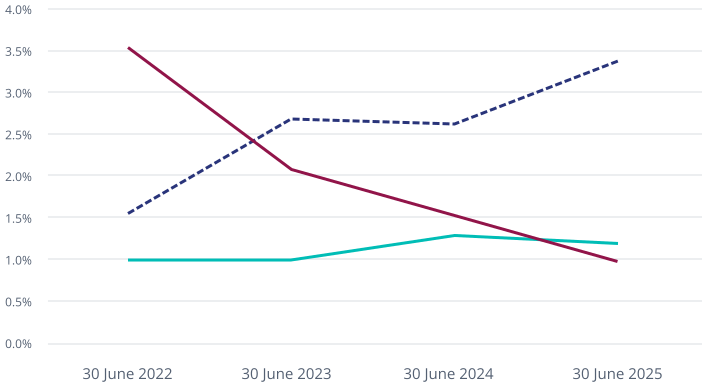
WACI is a commonly used measure endorsed by the Taskforce on Climate-Related Financial Disclosures (“TCFD”) and the Institutional Investors Group on Climate Change (“IIGCC”). It provides insight into emissions as a proportion of revenue, more commonly referred to as “carbon footprint”.
As at 30th June 2025, the WACI of the CUEF’s portfolio of active equity managers was 97.59 tCO2e/£m, a small decline on the prior year and a cumulative decline of -34.9% compared to 2021.
As at 30th June 2025, the WACI of the CUEF’s portfolio of active equity managers was 23.6% lower than the MSCI ACWI.
.svg)
UCIM’s primary lever for change is through relationships with the managers to whom it allocates capital.
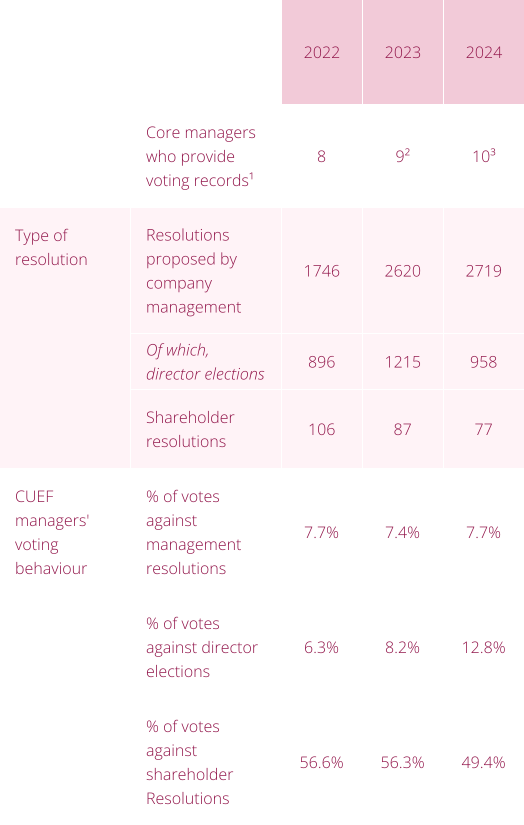
In 2024, following a comprehensive review of academic literature, industry best practices, and its manager capabilities, UCIM designed an enhanced approach and expectations for voting and engagement in public equities.
In 2025, UCIM engaged with its public equity managers to encourage the adoption of best practice.
Progress is encouraging. As a direct result of UCIM engagement, two managers improved their policies - one made its practices more impactful by committing to communicate the rationale for votes against directors to management teams; one updated its ESG policy to explicitly refer to climate change and began to engage with portfolio companies to initiate climate action plans. Another manager, which previously did not track or report voting activity, did so for the first time.
UCIM fully supported the process of the University’s Working Group on Investments in and Research Funded by Companies belonging to the Defence Industry.
The annual virtual “town hall” event for all members of the University community took place in February 2025, providing an opportunity for everyone to hear directly from the CEO and Chief Investment Officer, and ask questions. The town hall was recorded and made available on the University intranet.
UCIM engages with a number of investment sector organisations, providing an additional forum to share approaches, keep abreast of market developments and evolving best practice. Peers increasingly seek to learn more about UCIM’s sustainable investment strategy. UCIM also presents at industry conference, such as Responsible Investor Europe.
UCIM is a member of the Responsible Investor Network – Universities (“RINU”, part of ShareAction) and the Institutional Investors Group on Climate Change (“IIIGCC”).
UCIM maintains working relationships with other organisations, including Principles for Responsible Investment (“PRI”), and the Net Zero Asset Managers Initiative (“NZAMI”) and the Intentional Endowments Network (“IEN”), as well as a number of informal endowment investment networks.

.png)
The Principles are set by the Cambridge University Endowment Trustee Body (“CUETB”) in consultation with unitholders, UCIM and the Investment Advisory Board.
The Cambridge University Endowment Trustee Body (“CUETB”) defines Responsible Investment as “an approach to investment that explicitly acknowledges the relevance to the Fund of environmental, social and governance factors. It recognises that the generation of attractive long-term investment returns is dependent on stable, well-functioning and well-governed social, environmental and economic systems, including financial markets."
University of Cambridge Investment Management Limited (“UCIM”) is authorised and regulated by the Financial Conduct Authority in the UK with reference number 515843. UCIM is a private limited company incorporated in England and Wales with company number 06907395. Its registered address is The Old Schools, Trinity Lane, Cambridge CB2 1TN, UK. UCIM is the investment manager of the Cambridge University Endowment Fund (the “Fund”) which is an unregulated collective investment scheme as defined in section 235 of FSMA. The Fund is not available to the general public for investment. The purpose of this website is to inform visitors about UCIM’s business and activities. The information on this website, including all opinions or other content, is not intended to and does not constitute financial, accounting, tax, legal, investment, consulting or other professional advice or services but is for information purposes only. To the extent that this website contains information regarding past performance, you should be aware that past performance is not indicative of future results. UCIM and the Fund are not authorised or regulated in any country outside the UK and it may be unlawful to access the content of this website from outside the UK. If you choose to access information on this site, you do so at your own risk and it is your responsibility to comply with the applicable laws and regulations in countries outside the UK, including in particular, the United States of America. By entering this website you confirm agreement with the above information. For further detail, please read the Important Information page and our Privacy Policy.