Overview
Our Mission, Vision and Values
Performance Highlights
Letter from Chair of the Cambridge University Endowment Trustee Body
CEO and Chief Investment Officer’s Annual Letter



The Fund also provides distributions of approximately 4% of the net asset value of the fund per year. To achieve these objectives, UCIM’s investment strategy is to invest through specialist, third-party fund managers to access asset classes and geographies that it believes will outperform passive investments over time. This model enables UCIM, on behalf of the CUEF, to access what we believe are “best-in-class” investors, obtaining the benefits of diversification, while minimising overhead costs.
Within this strategy, the CUEF operates an “unconstrained”, global portfolio, allowing it to invest in any appropriate regions, sectors and asset classes. The Fund is diversified over five broad asset classes: Public Equity, Private Equity, Absolute Return and Credit, Real Assets, and Fixed Income/Cash.
UCIM seeks to select fund management partners with differentiated insights, disciplined processes and high integrity, whose interests and incentives are aligned with those of our stakeholders.
Consistent with the requirement to steward capital for the University, Colleges and Trusts for future generations, the CUEF has a very long-term investment horizon, and seeks to build durable relationships with its investment partners.
Public equity and private equity are viewed as the drivers of returns in the portfolio. Absolute return and credit, a subset of the hedge fund universe, is intended to reduce volatility and provide liquidity to the balance of the portfolio during market corrections. Real assets consist of real estate and renewable energy infrastructure.
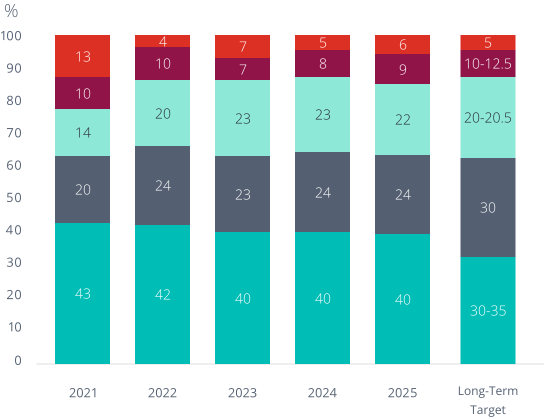
During the Financial Year, UCIM continued to make steady progress towards its long-term target allocation. Although UCIM has been incrementally increasing commitments to private equity, the CUEF’s asset allocation remained broadly stable during the year, due to the relative performance of that asset class.
In the 12 months to 30 June 2025, UCIM made commitments to two new public equity managers, two new venture capital funds and one new buyout manager. UCIM made additional commitments to 13 existing private equity fund managers, in whom it continues to have high conviction.
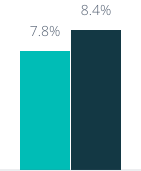
For the 12 months to 30th June 2025, the MSCI All-Country World Index excluding fossil fuels returned +8.4%. The key driver of equity market performance was investors’ continued enthusiasm for the AI-related growth story, principally focused on a narrow group of US technology companies.
In April and May 2025, there was material market volatility around the US administration’s announcement of broad-based tariffs on imported goods. This prompted an initial sharp sell-off in both equity and bond markets, which quickly reversed as the most punitive tariffs were paused.
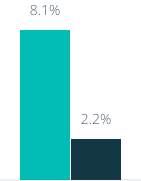
Although equity markets recovered, lingering uncertainty over US trade policy, growth and the deficit prompted a material outflow from the US Dollar, which declined -7.0% against a major basket of currencies during the second quarter of the Calendar Year. This impacted CUEF returns due to the Fund’s meaningful level of unhedged US Dollar assets.
Against this backdrop, the CUEF achieved a net return of +5.6% for the Financial Year.
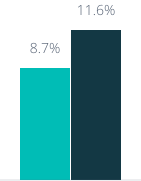
The CUEF’s public equity, absolute return and credit, and real assets portfolios all achieved attractive returns, both on an absolute basis, and relative to their respective benchmarks. In contrast, the CUEF’s private equity portfolio returned -1.2% net. Since 2022, market conditions in private equity have been challenging due to a lacklustre environment for exits and managers exercising caution in the valuations of their assets, which have lagged those in public markets. Returns in the CUEF's private equity portfolio were also impacted by the weakness of the US Dollar in 2025 (a large proportion of assets are denominated in US Dollar), the recency of many of the CUEF'scommitments to the asset class, and two write downs in legacy positions.
UCIM is pleased with the resilience displayed by the CUEF through the period of extreme market volatility in April 2025. In particular, the Fund was supported by its uncorrelated and highly liquid absolute return and credit portfolio, identified as a priority when UCIM developed its asset allocation strategy in 2020. This portfolio delivered positive performance during the volatile weeks following ‘Liberation Day,’ illustrating its potential to both mitigate volatility and act as source of capital for the broader CUEF during periods of equity market weakness.
Over the last five years, the CUEF has returned an annualised +8.2% net. Over the last ten years, the CUEF has returned an annualised +8.3%. These results compare favourably to a "65/35 Passive Portfolio" (defined in the Total Cumulative Net Returns graph in the Overview section), a proxy for the total return that might be achieved were the CUEF to be managed on a passive basis, which returned +7.2% and +7.8% over the past five and ten years, respectively.
In absolute terms, since 1st July 2020, UCIM’s management of the CUEF has increased investment value by over £1.5 billion adding over £220 million compared to a “65/35 Passive Portfolio”. Over the last ten years, CUEF returns have been line with its investment objective of consumer price inflation plus 5%.
.svg)


.svg)
.svg)
.svg)
.svg)
.svg)
University of Cambridge Investment Management Limited (“UCIM”) is authorised and regulated by the Financial Conduct Authority in the UK with reference number 515843. UCIM is a private limited company incorporated in England and Wales with company number 06907395. Its registered address is The Old Schools, Trinity Lane, Cambridge CB2 1TN, UK. UCIM is the investment manager of the Cambridge University Endowment Fund (the “Fund”) which is an unregulated collective investment scheme as defined in section 235 of FSMA. The Fund is not available to the general public for investment. The purpose of this website is to inform visitors about UCIM’s business and activities. The information on this website, including all opinions or other content, is not intended to and does not constitute financial, accounting, tax, legal, investment, consulting or other professional advice or services but is for information purposes only. To the extent that this website contains information regarding past performance, you should be aware that past performance is not indicative of future results. UCIM and the Fund are not authorised or regulated in any country outside the UK and it may be unlawful to access the content of this website from outside the UK. If you choose to access information on this site, you do so at your own risk and it is your responsibility to comply with the applicable laws and regulations in countries outside the UK, including in particular, the United States of America. By entering this website you confirm agreement with the above information. For further detail, please read the Important Information page and our Privacy Policy.